I am spending a little time each day working through Rashid Ziyatdinov, and Peter Dyson, GM-RAM: Essential Grandmaster Knowledge (2000).
One way that I am working through this book is to devote time to one of the 59 games each week. In late 2014, I went through a three of these games in some detail (see "Training with Anderssen," and "Anderssen -- Staunton 1851"). Understanding these 59 games lead to mastery of 120 middlegame positions (see "To Know a Position"). This week I am working through the Evergreen Game, which I have been through several times in the past. Several books on my shelf have detailed annotations of this classic game, including Graham Burgess, John Nunn, and John Emms, The World's Greatest Chess Games (1998). I am studying these annotations.
External works are essential to proper reading of Ziyatdinov's text. He explains:
Yesterday, I set out to find what Yuri Averbakh had to say regarding this position. Ziyatdinov lists Averbakh's Comprehensive Chess Endings. I have access to the Chess Digest edition, so started going through "Two Pawns v. One" in Yuri Averbakh and Ilya Maizelis, Pawn Endings, trans. Mary Lasher (1974).
I did not get far enough to discover whether this position is in this text. Instead, I worked through several somewhat more elementary positions. First, I played them rapidly against Rybka 4 to test my instincts. Then, I read what Averbakh had to say about each one.
The first presented no difficulties.
Stripes,James -- Rybka 4 x64
Blitz 5m Spokane, 02.01.2015
1.g4+ Kxg4 2.Kg6 c5 3.h4 Kxh4 4.Kf5 Kh5 5.Ke5 c4 6.Kd4 c3 7.Kxc3 ½–½
The second one required a second attempt because I did not calculate. My instincts were close, but wrong. Alas, there is no partial credit in chess games. A wrong answer can be fatal.
Stripes,James -- Rybka 4 x64
Blitz 5m Spokane, 02.01.2015
1.Kg7 e5 2.g4+
My first effort: 2.Kf6?? e4 3.Kf5 e3 4.g4+ Kxh4 5.g5 e2 6.g6 e1Q-+.
2...Kxg4 3.Kg6 e4 4.h5 e3 5.h6 e2 6.h7 e1Q 7.h8Q Qe4+ 8.Kg7 Qd4+ 9.Kg8 Qd8+ 10.Kg7 Qd7+ 11.Kg8 Qd8+ 12.Kg7 Qd7+ 13.Kg8 Qd5+ 14.Kg7 Qd4+ 15.Kg8 Qd5+ 16.Kg7 Qd3 17.Kg8 Qd8+ ½–½
The third position employs the same idea.
Stripes,James -- Rybka 4 x64
Blitz 5m Spokane, 02.01.2015
1.Ke7 b5 2.Ke6
2.d5?? Kxd5
2...Kf3!
Rybka played the least obvious of three drawing moves.
I expected 2...b4 3.d5 b3 4.d6 b2 5.d7 b1Q 6.d8Q Qa2+.
3.d5 b4 4.d6 b3 5.d7 b2 6.d8Q b1Q 7.Qf6+ Ke2 8.e4 Qxe4+ 9.Qe5 Kd3 10.Qxe4+ Kxe4 ½–½
After these three, I went back to the previous page in Averbakh's text. The first position is a simple matter of triangulation if White is on move. He offers solutions with both White and Black to move. I played these out against Rybka.
After two pages of Averbakh's Pawn Endings, I pulled another book off the shelf, Lazlo Polgar, Chess Endgames (1999) and glanced through the "Elementary Positions" section looking for similar positions. I played these against the box.
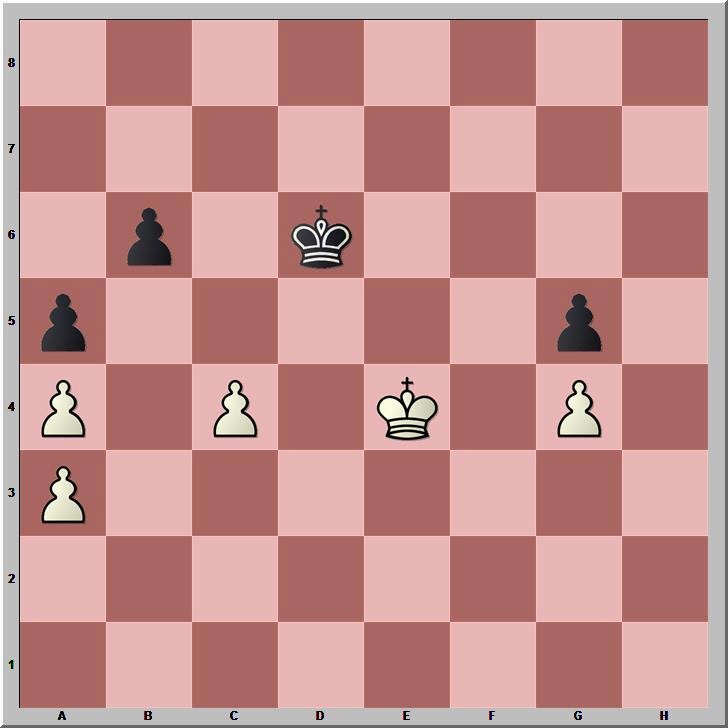
One diagram appears twice--with Black to move first, and then with White to move several pages later.
One way that I am working through this book is to devote time to one of the 59 games each week. In late 2014, I went through a three of these games in some detail (see "Training with Anderssen," and "Anderssen -- Staunton 1851"). Understanding these 59 games lead to mastery of 120 middlegame positions (see "To Know a Position"). This week I am working through the Evergreen Game, which I have been through several times in the past. Several books on my shelf have detailed annotations of this classic game, including Graham Burgess, John Nunn, and John Emms, The World's Greatest Chess Games (1998). I am studying these annotations.
External works are essential to proper reading of Ziyatdinov's text. He explains:
This book presents the key positions which must be known to achieve chess mastery. It does not undertake an explanation of them. There are other authors who have adequately explained the positions presented here. A list of references is included. (13)Studying the 133 endgame positions is another way that I am working through Ziyatdinov's text. Several years ago, I wrote a note in my copy of the text concerning diagram 16: "1-175 Dvoretsky presents more difficulties--kings on g5 and g7. White pawn on g4" (29).
 |
| GM-RAM Diagram 16 |
I did not get far enough to discover whether this position is in this text. Instead, I worked through several somewhat more elementary positions. First, I played them rapidly against Rybka 4 to test my instincts. Then, I read what Averbakh had to say about each one.
The first presented no difficulties.
 |
| Averbakh Pawn 145 |
Blitz 5m Spokane, 02.01.2015
1.g4+ Kxg4 2.Kg6 c5 3.h4 Kxh4 4.Kf5 Kh5 5.Ke5 c4 6.Kd4 c3 7.Kxc3 ½–½
The second one required a second attempt because I did not calculate. My instincts were close, but wrong. Alas, there is no partial credit in chess games. A wrong answer can be fatal.
 |
| Averbakh Pawn 146 |
Blitz 5m Spokane, 02.01.2015
1.Kg7 e5 2.g4+
My first effort: 2.Kf6?? e4 3.Kf5 e3 4.g4+ Kxh4 5.g5 e2 6.g6 e1Q-+.
2...Kxg4 3.Kg6 e4 4.h5 e3 5.h6 e2 6.h7 e1Q 7.h8Q Qe4+ 8.Kg7 Qd4+ 9.Kg8 Qd8+ 10.Kg7 Qd7+ 11.Kg8 Qd8+ 12.Kg7 Qd7+ 13.Kg8 Qd5+ 14.Kg7 Qd4+ 15.Kg8 Qd5+ 16.Kg7 Qd3 17.Kg8 Qd8+ ½–½
The third position employs the same idea.
 |
| Averbakh Pawn 147 |
Blitz 5m Spokane, 02.01.2015
1.Ke7 b5 2.Ke6
2.d5?? Kxd5
 |
| Pawn race produces a queen ending |
Rybka played the least obvious of three drawing moves.
I expected 2...b4 3.d5 b3 4.d6 b2 5.d7 b1Q 6.d8Q Qa2+.
3.d5 b4 4.d6 b3 5.d7 b2 6.d8Q b1Q 7.Qf6+ Ke2 8.e4 Qxe4+ 9.Qe5 Kd3 10.Qxe4+ Kxe4 ½–½
 |
| Averbakh Pawn 143 |
One diagram appears twice--with Black to move first, and then with White to move several pages later.
 |
| Two in Polgar |
Detail:
Training Regimen