Showing posts with label Spokane. Show all posts

The Critical Position

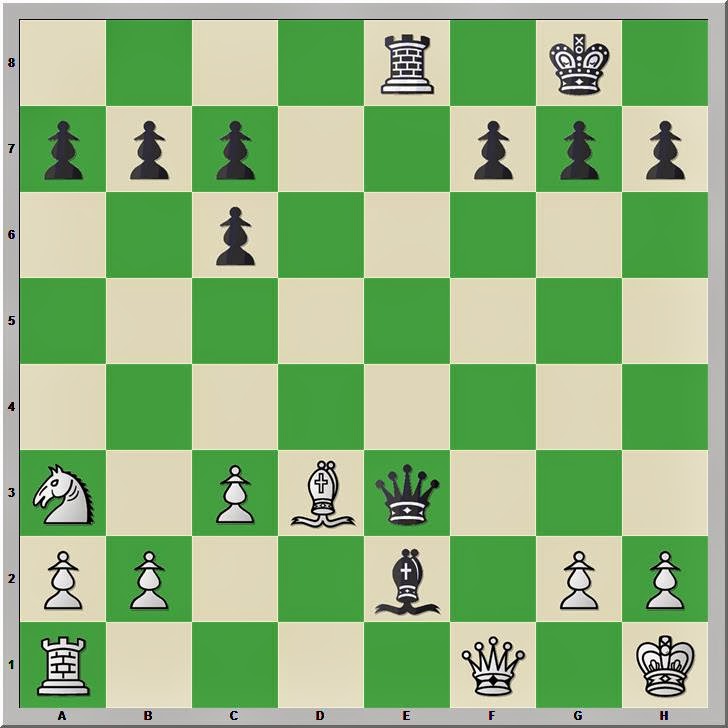
This position comes from my round two game against Bob Rajala in the 23rd annual Collyer Memorial. He played a Caro-Kann, and I struggled to find an advantage. We reached a position where I thought that I could be in trouble with a single inaccuracy.

Black to move

Bob played 28...Qg6, much to my relief. I exchanged my rook for his bishop and knight, and ten moves later he resigned.

I expected, and he had planned, 28...Qg5!

Should I play 29.g3 or 29.g4?

Taking Care of Business

My friend John Julian always reminded me that high rated players must take care of business in the early rounds of a Swiss tournament. That is, players in the upper quarter will be paired against players that they are expected to beat. They need to do so. In a two-day Swiss, the tough games come on the second day.

Taking care of business is not always easy.

I have had a cold this past week, and today the congestion resulted in a persistent headache. It was not terribly severe, but it refused to leave. Combine the headache with with my penchant for photographing as many players as possible during the early rounds of Spokane's weekend tournaments, and I was in a bit of trouble before I became properly focused on my first round game.

I recall a conversation with my opponent between rounds during last year's Collyer Memorial. He drove up from Oregon to participate in the event. This game was the first time that we played.

My opponent opted for the Ponziani, which had been my new weapon last year. It made the beginning of the game psychologically difficult. I spent six minutes on my third move.

Beverly,Jacob (1462) -- Stripes,James (1872) [C44]
Collyer Memorial Spokane (1), 28.02.2015

1.e4 e5 2.Nf3 Nc6 3.c3 f5

I think that Paul Morphy might have played this move were he in my seat.

4.exf5 e4 5.Qe2N

Black to move

5...Be7?

I have learned playing the Ponziani that opponents often freak out, so, I freaked out and blundered a second pawn after intentionally sacrificing a first.

5...d5 seems best.

6.Qxe4 Nf6 7.Qc2 d5 8.Bb5 0–0 9.Bxc6

9.d4 was better.

9...bxc6 10.0–0

Black to move

10...Ne4

I was rushing to win back one of the pawns. Morphy, on the other hand, would find the best squares for his pieces.

11.d3

As expected, and best.

11...Nd6 12.Nd4

Here, I became alert to many threatened knight forks that interfered with my plans.

12...Qd7 13.Nd2

13.g4

13...Nxf5 14.Nxf5 Qxf5 15.Nf3 Bd6 16.Be3

16.Nd4 was better.

Black to move

16...Qg6

I don't know how I missed  16...Qh5 as that was part of my intent behind 15...Bd6. I spent seven minutes on Bd6 and two on Qg6.

17.Nh4 (17.g3 Rxf3) 17...Qxh4-+.

I considered 16...Qg4 17.Nd4 (17.h3? Qh5 18.Ne1 Qe5 19.g3 Bxh3-+).

17.Ne1

17.Nh4 Qh5 18.g3 Bh3-+.

17...c5 18.f4 Bf5 19.Qb3 c6 20.Rd1 Bg4

White to move

At this point in the game, I had used a full hour to my opponent's 25 minutes.

21.Rd2 Rfe8 22.Nc2 Rab8 23.Qa4

Black to move

23...Bf8

I spent fifteen minutes on this move.

23...Rxb2 occupied much of my long think. I was uncertain, and so played a move that seemed safer. 24.Qxc6 Rxc2 25.Qxd5+ Qe6 was not my likely move, although it is the only one in the position that leaves Black with an advantage.

24.b3 Rb7 25.Qa5 Bf5 26.Bxc5

Black to move

26...Bxd3

26...Rb5 was suggested by Darren Russell during the post-mortem. It is the computer's top choice.

27.Rfd1

27.f5 Bxf5 28.Nd4

27...Bxc2–+ 

Finally, I am winning. At this point I had 37 minutes left on the clock.

28.Rc1 Be4 29.c4 Bd6 30.g3 Bxf4 31.Rf1

Black to move

31....Bxd2 

I didn't even consider 31...Bxg3 which leads to checkmate in seven moves.

 32.Qxd2 Rf7 33.Re1 Rf3 34.Bf2 Ref8 35.cxd5 cxd5 36.Bc5

Black to move

36...Rxg3+

I found the checkmate in three. Indeed, I had been trying for it for several moves prior.

37.hxg3 Qxg3+ 0–1

In round two I had a more difficult game against the Caro-Kann that seemed roughly equal well into the middlegame. As I was organizing my forces to create attacking chances, I overlooked the danger of my opponent's counterplay. Then, he moved his queen to the wrong square, allowing me to exchange a rook for two minor pieces and end his prospects for attack.

With my bye in round three, I start round four tomorrow morning with 2 1/2, which is what I expect in weekend Swiss.

Top 100!

It never crossed my mind that I would be on any list of the Top 100 chess players, although it might have. When I reached my peak USCF rating slightly more than two years ago, I was in the top 60 active players in my state.

But a Top 100 national list is another matter. Hence it came as a surprise in July when I received an email from the USCF seeking to verify my age because I may be eligible for a Top 100 list. I provided the verification and then checked the list. My rating was several points below number 100.

A week or two later, I played in a local event at the my chess club and tied for first with an 8-1 score. I beat the other top player in our individual encounter, but lost to one of those who finished at 6-3. My USCF Blitz rating shot up from 1894 to 1939. That would have put me at number 92 on the August list. However, my new rating become official on September 1.


Top 100 list are updated at mid-month, but staff vacation delayed the September lists. I had to wait a long time, but I am now officially on the list of the Top 100 USCF Blitz Players over the age of 50! I am number 96. I likely will drop from the list next month.

There is no one else from my state on the list. That absence is a function of the newness of the USCF blitz rating and the paucity of events. The list cannot be taken too seriously. I am certain there are some players in Seattle my age or older who can school me at blitz. Even so, it's nice to be on a list.
Detail: Top 100!

Faltering Against the Dutch

My game against Jeremy Krasin did not go as planned. I did not win. In the Spokane Contenders Tournament, I had White against Jeremy. I also had White in 2012, winning that game and the event. At the end of the 2012 Spokane Contenders, I reached my highest ever USCF rating of 1982.

Stripes,James (1917) -- Krasin,Jeremy (1882) [A90]
Spokane Contenders Spokane, 24.07.2014

1.d4 e6!

Krasin offers me the White side of the French. As everyone in Spokane knows, the French is my main Black weapon against 1.e4. It might be expected that I prefer to avoid playing the White side. In fact, I play the White side with some frequency as I play 1.e4 as often as I play 1.d4.

If Krasin intends to play the Dutch Defense, this move has the virtue of preventing me from Playing the Raphael Dutch and the Staunton Gambit. My experience with the Raphael is well known by those who have observed the Spokane scene the past few years, and Krasin has played against it in several blitz games. He also lost to the Staunton Gambit in the 2012 Spokane Contenders.

2.g3 f5

Indeed, the Dutch was his plan.

3.c4 Nf6 4.Nc3

4.Bg2 is more accurate.

4...c6

White to move

Can White play 5.d5? I thought about it, and we looked at it after the game. I thought that 5...Bb4 would be Black's best response.

5.Bg2

5.d5  was played by a master against an expert. That game continued 5...Bb4 6.Bg2 0–0 7.Bd2 e5 8.Nf3 Qe7 9.0–0 b6 10.a3 Bd6 11.e4 cxd5 12.exd5 e4 13.Nd4 Ne8 14.Qe2 Na6 15.b4 Be5 16.Be3 Qf6 17.Rad1 Bb7 18.Ncb5 Nd6 19.f4 exf3 20.Nxf3 1–0 Neubauer,M (2433)--Maia,J (2128) Rio de Janeiro 2011

5...d5 6.cxd5?!

My move scores poorly in the database. I played it to avoid the loss of the c-pawn--a beginner's error. If I'm unwilling to suffer the temporary loss of that pawn, I should not be playing the Queen's Gambit.

6.Nh3 appears to be most popular among strong players.
6.Nf3 is the most popular move in the database overall It has been played by Etienne Bacrot and Mihai Suba.
6.Bf4 has been played by Ivan Sokolov on more than one occasion.

6...exd5 7.Bg5

I would like to trade my dark-squared bishop for Black's knight or dark-squared bishop. But, I have some ambivalence concerning the trade for the knight.

7...Be7

I was feeling here that Black already had a slight advantage.

8.Nf3 0–0 9.Qc2

Black to move

9...Na6 10.a3

Preventing Nb4 is an exercise in chasing phantoms. But if a3 is a necessary part of my planned minority attack, then perhaps it is not a wasted move.

10...Nc7 11.0–0 Ne6 12.Bd2 Ne4

It is clear that Black has the iniative.

13.b4 Bf6 14.e3 g5

White to move

I spent a lot of time on this position and was not happy with any of my plans. I decided that I needed to secure f4 as a possible knight outpost, while also protecting my d-pawn.

I did consider 15.Nxe4 fxe4 16.Ne5 but thought that I would end up with a pawn on e5 that was hard to protect. As it turned out, I had such a pawn in any case, and I underestimated its dynamic potential.

15.Ne2 Bd7 16.a4 b6 17.Ne5 Bxe5 18.dxe5 Rc8 19.Bc1!

In retrospect, from the end of the game, this bishop proved to be valuable.

19...g4 20.a5

20.Rd1 should have been considered.

20...Qe8 21.Nf4 N6g5

White to move

22.f3?

22.Bb2!
22.axb6! axb6 23.Bb2 and White may gain the iniative. The pawn on e5 sticks in the middle of Black's forces, preventing many arrangements of his pieces that might be useful for exploiting the apparent weaknesses around the White king. My fears about Nf3+ and a Black pawn taking up residence on f3 in preparation for Black's queen penetrating along the h-file appear unfounded.

22...gxf3 23.Bxf3 Nxf3+ 24.Rxf3 Ng5 25.Rf2 Qxe5 26.Qb2

Black to move

26...Qxb2

During the game, I thought 26...Qe4 might continue to cause me grief. Krasin and I looked at a few lines following this move during the post-mortem.

27.Bxb2 b5 28.Kg2 Rce8 29.Bd4 a6 30.Rc1 Ne6 31.Nxe6

31.Nd3 is a move preferred by Stockfish.

31...Rxe6 32.Rf4 Re4 33.Rcf1 Kf7 

White to move

34.Rxe4 dxe4 35.Rd1 Ke8 36.Bc5 Rf6 37.Kf2 Rg6 38.Rd6 Rxd6 ½–½

It is clear that I need more weapons against the classical Dutch. The Raphael is insufficient.

After this game, my only chance to play in the City Championship was to win my last two games and also get help from David Dussome, who would need at least a draw against Michael Cambareri. Alas, I lost to Cambareri the next day, giving him clear first in the Contenders Tournament. Had he then beaten Dussome, his chances of going over 2000 with his rating was quite good. He lost to Dussome. Dussome thus beat the top two rated players in this event.

I have one game remaining in the event.

Preparing to Slay the Dragon

I have an opponent who plays the Dragon variation of the Sicilian Defense. Rather than playing 1.d4, which is my top choice in USCF rated chess, I plan to court his Dragon. I need to meet players at their strength in order to improve my skill. I do not know how well my opponent understands the Dragon, nor how he has studied the opening. His games on Chess.com are too few, and his opponents too quickly deviate from sensible book lines.

This post documents my two days of preparation for a single chess game. I am beginning this article on Tuesday morning, the game is scheduled for Wednesday evening, and I plan to post on Thursday.

This game is my second in the 2014 Spokane Contenders Tournament. Participants in this six-player round robin earned their spots. I am in the event because I played in and lost last year's City Championship Match. The others either won club events or finished near the top in the Grand Prix. The winner of the Contender's Tournament earns a position as challenger in this year's City Championship.

I am the second highest rated player in the 2014 Contender's with a USCF rating of 1917. My opponent is the fifth highest and rated 1694. His rating was provisional this spring. He is a relative newcomer to competitive chess and is improving fast. His first rated event was last August.

Tuesday Morning

After walking my dogs and eating breakfast, I started this blog post.

The Sicilian Dragon is ECO B70-79.* My first step is to open my personal database of previously played games matching those codes and review them. My search turns up 406 games. Reviewing them all would be daunting.

To get some control over this mass of data, I sorted by Black's rating in order to review games against my highest rated opponents. My own name appears near the top in the Black list, indicating that I, too, play the Dragon. I will review those too.

One recurring pattern crops up:

After 1.e4 c5 2.Nf3 d6 3.d4 cxd4 4.Nxd4 Nf6 5.Nc3 g6 6.Be3 Bg7, I have often played 7.Be2. This move does not score as well as the more popular 7.f3. Even so, it may be worth considering.

Black to move

My post, "Losing Pawn Wars," came from a Dragon in which I played 7.Be2.

There are also games where I play 6.Be2, which has been played by Kramnik, Kamsky, Nepomniachtchi, and other top Grandmasters. 6.Be2 is the Classical Variation.

Looking through about two dozen games sorted thus, it is clear that my losses are characterized by gross tactical blunders. My wins also profit from blunders by my opponents. The key to my preparation, it seems, should be to seek lines that apply such pressure as to provoke opportunities for miscalculation.

In some losses, I simply drop pawns.

Having spent some time on the model game, Karpov -- Korchnoi, 1974, it comes as no surprise that I have attempted in online blitz to imitate Karpov's winning strategy. This game is an example of one failure in these efforts.

Stripes (1657) -- Internet Opponent (1819) [B78]
FICS 2013

1.e4 c5 2.Nf3 d6 3.d4 cxd4 4.Nxd4 Nf6 5.Nc3 g6 6.Be3 Bg7 7.f3 0–0 8.Bc4 Nc6 9.Qd2 Bd7 10.Bh6 Ne5 11.Bb3 Rc8 12.0–0–0 Nc4 13.Bxc4 Rxc4 14.Bxg7 Kxg7 15.Nde2 Qa5 16.h4 h5 17.Qg5 Rc5 18.Qe3 Be6 19.Nd4 Bxa2 20.Nxa2 Qxa2 21.Qb3 Qa1+ 22.Kd2 Qa5+ 23.Ke2 Rfc8 24.Qd3 Rc4 25.g4 hxg4 26.fxg4 Nxg4 27.h5 Ne5 28.Qg3 Rxd4 29.Rxd4 Rxc2+ 30.Kf1 Qa1+ 31.Qe1 Rc1 32.h6+ Kh7 33.Ke2 Rxe1+ 34.Rxe1 Qxb2+ 35.Rd2 Qb5+ White resigns 0–1

One factor that looms clear in my review of these games is a lack of precision in the opening. This weakness is not surprising. I have long been of the opinion, expressed frequently in internet forums, that class players should not spend a lot of time studying openings. Rather, tactics and endgames should be the primary focus. Openings can be played on general principles.

Against the Dragon as well as other variations of the Sicilian Defense, I have not developed precise, booked-up responses. Rather, I seek to deploy my pieces to good squares. Most often my bishops go to e2 and e3 with little regard for Black's set-up, but on occasion I will try Bb5 or Bg5. As all of the 400+ games in my database are from blitz, many of these games represent liberal use of premove (making a move on the screen that will be executed after my opponent moves so long as it is legal).

At my current level, however, further progress calls for serious opening study. I need stronger opening preparation to beat the Experts whom I must beat to become an Expert myself. It may be less important to prepare an opening in order to face a B Class player, but is it not a waste of time.

After a bit over an hour reviewing my own games, it seemed time for a quick review of basic ideas and plans as explained by Nick DeFirmian (Modern Chess Openings, 13th edition [1990]).**

DeFirmian's simple summation is useful for organization.

Yugoslav Attack

"The Yugoslav Attack ... is White's most successful antidote to the Dragon" (246).

My database contains 108 games with the position reached after 1.e4 c5 2.Nf3 d6 3.d4 cxd4 4.Nxd4 Nf6 5.Nc3 g6 6.Be3. I was White in 105 of these, scoring 48-6-51 WDL. Improvement is needed.

Black to move

I find that I am playing h2-h4 too early.

DeFirmian gives as the main line from the diagram 6...Bg7 7.f3 Nc6 8.Qd2 O-O, although Big Database 2012 with The Week in Chess updates reveals that 7...O-O is slightly more frequent than 7...Nc6. The order of popularity at the highest levels, however, is as DeFirmian describes, although 7...O-O remains popular at the top.

In my games, 9.h4 accounts for many of my losses. After 9.Bc4, I score 56.5%. I fare poorly after 9.O-O-O, although that move scores well in Big Database 2012.

Hence, I studied one loss in more detail, with an eye to understanding both the most precise move order and the central ideas.

Stripes,J (1770) -- Internet Opponent (1855) [B79]
Chess.com, 2013

1.e4 c5 2.Nf3 d6 3.d4 cxd4 4.Nxd4 Nf6 5.Nc3 g6 6.Be3 Bg7 7.f3 0–0 8.Bc4 Nc6 9.Qd2 Bd7 10.0–0–0

10.h4 is worth considering here.

10...Qa5 11.Nb3?!

Possibly the beginning of my problems. 11.Kb1 and 11.Bb3 are preferred by the top players.

11...Qc7 12.g4?

Another inaccuracy. 12.Bh6 was better.

12...Rfc8 13.Bd5? Ne5 14.Qf2? Nc4 15.Bxc4 Qxc4 16.h4=

That my further errors led to an even game is a symptom of blitz. The value of this game for opening study ends here.

16...a5 17.h5 a4 18.Rd4 Qc6 19.Nd2 a3 20.Rc4 axb2+ 21.Kxb2 Qa6 22.Rxc8+ Bxc8 23.Nb3 Be6 24.Bd4 Qa3+ 25.Kb1 Bc4 26.hxg6 fxg6 27.g5 Nh5 28.Bxg7 Nxg7 29.Qd4 b5 30.f4 Ne6 31.Qd2 b4 32.Nd5 Qxa2+ 33.Kc1 Bxb3 34.Nxe7+ Kf8 35.Nxg6+ hxg6 0–1

I continued this process for a few more games.

Classical Variation

I fare better after 6.Be2 (53.4%). Here, though, my move order rarely follows that DeFirmian gives as the main line, 6...Bg7 7.O-O O-O 8.Be3 Nc6. I tend to play 7.Be3 first. I also castle on the queenside often enough to reveal that I confuse the classical system with the Yugoslav attack.

Levenfish Variation

I find only six games where I played 6.f4 and I lost four of those.

Other Ideas

I find that I have frequently played 6.Bg5, scoring over 53%. This move has been an occasional weapon of top players, but generally scores less well than the Yugoslav and classical variations. I shall concentrate on honing my understanding of the correct move order on those two.

Tuesday Afternoon

It is not possible to spend the whole day studying chess, nor is it productive. The morning session, which was interspersed with other activities, was not highly efficient. But, it did serve to identify weaknesses in my play against the Sicilian Dragon.

My afternoon session was shorter and better focused. I spent an hour going through the B70 lines in the Encyclopedia of Chess Openings that feature 6.Be2 (the classical variation). These are lines 3-12. they contain an abundance of variations and links to important reference games. The electronic version is a nice resource.

At this moment, I am aiming for 1.e4 c5 2.Nf3 d6 3.d4 cxd4 4.Nxd4 Nf6 5.Nc3 g6 6.Be2 Bg7 7.O-O O-O 8.Nb3 Nc6 9.Re1. This plan may change.

Black to move

Ideas here include overprotection of the e4 pawn for when the knight on c3 is kicked, retreat of the light-squared bishop to f1, deployment of the dark-squared bishop on g5 to put pressure on e7 or to provoke h7-h6. Black has many choices. By looking through several of the reference games in ECO, however, I should be familiar with common patterns.

Of course, my opponent has plenty of opportunities to deviate from main lines of the Dragon, to try the Accelerated Dragon, or to avoid the Dragon altogether. He could even try the French.

Tuesday Evening

While sipping wine on the deck with my wife, I spent a little time going through games via the ChessBase iPad app. I set the position in the diagram above as my search parameter. There were several hard-fought draws between 2700+ players.

Wednesday Morning

During coffee, I looked through some games in Chess Informant, including CI 113/69, from which a position appeared on this blog last October ("Expose the King").

After walking the dogs and then spending some time at work (I work at home most of the time), I reviewed some recent games via The Week in Chess. One that went badly for White merits study.

Malloni,M (2350) -- Mogranzini,R (2499) [B70]
46th TCh-ITA 2014 Condino ITA (6.1), 03.05.2014

1.e4 d6 2.Nc3 c5 3.Nf3 Nf6 4.d4 cxd4 5.Nxd4 g6 6.Be2 Bg7 7.0–0 0–0 8.Bg5 Nc6 9.Nb3 Be6 10.Re1 a5 11.a4 Rc8 12.Bf1 Nb4 13.Nd4 Bc4 14.Ndb5 Bxf1 15.Rxf1 Qd7 16.Re1 Qe6 17.Rc1 Rc5 18.Be3 Rc4 19.b3 Nxe4 20.bxc4 Nxc3 21.Nxc3 Bxc3 22.Bd2 Qxc4 23.Bxc3 Qxc3 24.Rxe7 d5 25.Re3 Qc4 26.c3 Rc8 27.Rb1 Na2 28.Rxb7 Nxc3 29.Qe1 Ne4 30.Qa1 Qxa4 31.Re1 Qc6 32.Rb2 a4 33.Ra2 Nc3 34.Rd2 Qc5 35.Re3 d4 36.Red3 Rb8 37.Rb2 Rxb2 38.Qxb2 a3 39.Qb8+ Kg7 40.h3 a2 41.Qa8 Qb5 0–1

White's eighth move offers choices. What is the optimal move order? Should White play Nb3 before Black commits to Nc6? Is 8.Bg5 accurate, or should it follow Re1?

Yesterday's move order (above) derives from the Encyclopedia of Chess Openings. Is it optimal? It also appears in DeFirmian's MCO-13.

8.Nb3 first appeared in Chess Informant in Timman -- Miles, Luzern 1982 (CI 34/260). It is one of the reference games that I examined during my morning coffee. I marked it as deserving further study. Tony Miles won that game brilliantly, but the next issue of Informant had a second game with 8.Nb3, which was won by White. Although my search does not turn up earlier instances of 8.Nb3, Miles' annotations identify his 8...Nbd7 as the game's novelty.

Scrolling through the 78 games in CI 1-113 that contain the position after 1.e4 c5 2.Nf3 d6 3.d4 cxd4 4.Nxd4 Nf6 5.Nc3 g6 6.Be2 Bg7 7.O-O O-O, I find many instances of 8.Kh1, 8.Bg5, 8.Be3, and 8.Nb3. The earliest instance of 8.Re1 appears in Ermenkov -- West, Novi Sad 1990 (CI 50/[233]) and Ermenkov -- Chandler at the same event and with the same CI number. Again, 8.Re1 is not presented as a novelty. Perhaps, transpositions in move order are the reason the move is not considered new.

ChessBase has 8.Re1 in Basman -- Cooper 1972. Cooper's rating of 1830 suffices to keep the game out of Chess Informant.

The position after 8.Re1 appears in thirteen games in Informants 1-113. I am going through all of these games and the annotations. Although I remain uncertain that 8.Re1 is the optimal move order, I am leaning towards that move this afternoon. I will hold Nd4-b3 in reserve to meet Nc6 should my opponent play that move before castling.


The Game

Stripes,James (1917) -- Dussome,David (1694) [B70]
Spokane Contenders Spokane, 09.07.2014

1.e4 c5 2.Nf3 d6 3.d4 cxd4 4.Nxd4 Nf6 5.Nc3 g6 6.Be2 Bg7 7.0–0 0–0 8.Re1 Nc6 9.Nb3

We reached the position that I prepared via the move order I settled upon this morning.

9...Be6 10.Bf1 Rc8 11.Nd5 Ne5!

White to move

Despite my preparation, I had not examined this move.

12.c3

My move has been played by strong Grandmasters, as has the immediate 12.Bg5.

12...Bg4

I expected 12...Nc4, and was not certain that I would play 13.Bxc4.

13.f3 Bd7 14.Bg5

Black to move

14...a5

14...Nxd5 was played in the only remaining reference game.

15.a4

I considered 15.Nxf6, but my hopes of winning the d-pawn were easily refuted. I spent twelve minutes on this move--my longest think of the game. My move is the third choice of Stockfish. 15.Bxf6 was probably best, although I considered this move for only a moment.

15...Nxd5 16.Qxd5?!

Originally, I planned 16.exd5, which was better.

16...Be6 17.Qb5 b6 18.Nd2!?

The computer likes 18.Nd4, which I considered. Despite my 12.c3, I found myself concerned for the safety of my b-pawn as the vulnerability of my queen and knight facilitate Black's efforts to mount an attack.

18...Rc5 19.Qa6 Nc4

White to move

20.Nxc4

20.Bxe7! would have given me an advantage. I did not spend enough time on this move. My opponent had spent ten minutes on 19...Nc4. I needed to make certain that I understood all that he was looking at.

20...Bxc4 21.Bxe7?

21.Bxc4 Rxg5 was much better, preserving a balanced game.

21...Bxf1!

I missed this move in my calculations. My preparation gave me a position that I liked, although my opponent, too, liked his position. He won because he calculated better than me.

22.Qa7 Rc7 23.Bxd8 Rxa7 24.Bxb6 Ra6 25.Be3 Bc4

White to move

I resigned a few moves later. It was a tough loss, and yet I feel that I gained something from the experience of preparing and playing the Classical Variation against the Dragon. My opponent demonstrated that he understand the Dragon well. His tactical skill is strong. He will become one of our city's top players.


*ECO Code is a trademark of Chess Informant.
**I use an old, out of date edition of MCO because I invested in the Encyclopedia of Chess Openings, which I use more extensively. I have ECO both in print and electronic formats.

The Camp Workbook

This morning concluded my seventh summer chess camp for elementary age chess players. The first camp was in June 2008 and drew only youth from Deer Park School District, where the camp was part of a very active summer enrichment program. With permission of the summer coordinators, I began recruiting students from outside the district in 2009. The second year, the three hour block was split: 1:45 for the advanced camp and 1:15 for the beginning camp. This time seemed too short for strong youth players, but about right for beginners.

In 2012, I moved the camp to a private school where I was now coaching.* At the new school, I restored the three hour block and extended the camp from four days to five. Although I do not run a beginners camp, a few beginning players join each year. I make accommodations for them with some separate activities. Sometimes I produce a separate workbook for the beginners.

A distinctive element of my camp is the camp workbook. I do not know how common this element is among others who run camps for young players. I am certain that I am not unique. Even so, my changing themes year after year put me outside the norm.

My workbooks generally include annotated games, other related games presented without comments, tactics problems and a short glossary of tactical motifs, essential pawn positions. Some workbooks have more endgame positions, some less. Some elements of the workbooks are carried over from previous years.

My first two camps used the same workbook, except for the date on the cover. In 2010, my camp theme was "Attacking with Anderssen." The 56 page workbook contained several Anderssen games that I annotated for young players (see the link for an example). Also, the tactics problems stemmed from Anderssen's games. I reworked some of these annotations for this year's camp.

In all my camps, awards at the end of the week are based on accumulated camp points. Youth earn camp points for good behavior, solving chess problems, recording their games in the camp tournament, answering questions during presentations, and so on. The winner of the camp tournament does not always accumulate the most points, although that win is also worth some points.

In 2011, I produced my shortest camp workbook (41 pages), but edited it carefully. The focus was Vasily Smyslov's search for truth. I also found tactics puzzles from Smyslov's play. A section from that workbook on rook endings was imported into this summer's workbook, too, but was not included in the camp curriculum. The workbooks always contain more materials than we have time for in camp. Ambitious students go home with study material that will carry them through the summer.

The 2012 camp and workbook profiled a different chess player each day: Jozsef Szen, Paul Morphy, Mikhail Tal, Alexander Chernin, and Yasser Seirawan. This year's workbook recycled some of my materials on Morphy, which are built on the solid work of Valeri Beim, Paul Morphy: A Modern Perspective (2005).

In 2013, I omitted the endings from the workbook, although pawn wars remained part of the week's activities. This ambitious workbook of 59 pages was almost all new material. It had a long section on Gioachino Greco that was built on my work converting all the games and fragments from William Lewis, Gioachino and the Game of Chess (1819) into ChessBase format. Unfortunately, I failed to back-up this database and my hard drive crashed a month after camp. The material included in the workbook is all that remains. There was a shorter section on François-André Danican Philidor, which was also based on work with an old English text.

Most of the materials in this year's workbook were revisions of materials from previous years. However, I added a wholly new section: teacher vs. student. For many years, I have notated games played with young chess players during their chess club practice. I annotated two of these games for the workbook to highlight common errors made by young novice players. A camp theme was learning from errors.
Mistakes are part of chess. It is often said that the winner of a game was not the player who made no mistakes. Rather, the winner made the second to the last mistake. 
Good chess players learn from their own errors. After the game, they analyze with their opponent and often with a stronger player or coach. They seek to understand where they might have improved their play. Even wins are subjected to critical analysis. 
Better chess players learn from mistakes made by other players. The best chess players invest a lot of time studying other players’ games. They look for patterns that will be useful in their own games. They practice finding the critical errors and seeking better moves. They look for new ideas.
Stripes, "Dragon Chess Camp 2014: Basic Training for Chess Success" (7).
After presentation of one of these games, students worked together to identify the errors in a batch of other student vs. teacher games. Among their tasks was to try to discern which player was the teacher.

I also added checkmate in one problems to the start of the tactics problems at the back of the workbook. These proved helpful to the beginning students while also building confidence for the stronger players. At 87 pages. it was my longest workbook so far.


*I continue to coach the teams in Deer Park, as well. I started coaching chess in Deer Park as a parent volunteer, becoming a paid coach when we moved out of the district.

Missing Things

In my first game of the 2014 Spokane Contenders,* my opponent gave me a pawn early. It seemed to me that he was then trying to generate some tactics to win it back. Somehow, we both missed the moment when he could have done so.

Black to move

I played 16...Nf4. There were several better moves that maintain both the extra pawn and a positional advantage.

Other than this one lapse, my play was solid. I won the game.

*Entry to this tournament is via a system of qualification. There is no entry fee. The players work out the times and places of the games. All games must be completed by August 3. It began just before Memorial Day weekend. The tournament winner becomes the challenger in the Spokane City Championship in mid-August. I won the Contenders Tournament in 2008, tied for first in 2010 (but second on tie-breaks), and again won in 2012.

Beating Nikolay

Nikolay Bulakh is the Spokane City Champion, a title that he earned beating me 2 1/2 - 1/2 in a match last summer. A few years ago, I was having a good run against him. Although every game was tough, it seemed that I always won. He beat me for the first time in a standard tournament game in our club's 2013 Winter Championship, then beat me in a quick event a week later. He won the first two games of the City Championship to make it three standard wins in a row. In game three of the match, I might have had some winning chances, but missed them and drew.

Friday night, before our blitz game, we were discussing this summer's City Championship, which could be a rematch of last year. I commented that getting past Michael Cambareri and Jeremy Krasin will be tough, and "I'm not getting any younger." To play in the City Championship, I need to win the Contender's Tournament. "Your rating is not getting higher, either," Nikolay noted. It is true that I have dropped to 1900 from my peak of 1982, and was briefly 1899.

I won the blitz game, but lost games to Michael and Jeremy. Michael won the blitz tournament. Jeremy was second. I was third, and Nikolay finished fourth.

In round four of the Inland Empire Open, I had White against Nikolay on board two. Michael was on board one against Cameron Leslie. They were the only players with 3.0. Jeremy was on board three. Nikolay, Jeremy, and I were the only players with 2.5.

Stripes,James (1900) -- Bulakh,Nikolay (1980) [A29]
Inland Empire Open Spokane, 18.05.2014

1.g3!?

The Benko Opening earned its name at the 1962 Candidates Tournament in Curaçao. Pal Benko played it in his first eleven games with the White pieces, beating both Bobby Fischer and Mikhail Tal. It usually transposes into something else.

1...Nf6 2.c4 e5

We have an English Opening, Sicilian Reversed. In the 1990s, the English was one of my main weapons with White. I have some experience on the Black side as well.

3.Nf3?!

3.Bg2 is more accurate.

3...Nc6 4.Nc3 b6 5.Bg2 Rb8 6.d4 exd4 7.Nxd4 Bb7N

White to move

8.e4?

I did not like 8.Nxc6 Bxc6 9.Bxc6 dxc6 10.Bg5 or 10.Qa4, but it was better than my choice.

8...Bb4= 9.Nde2?!

9.0–0 is better.

9...Ne5 10.0–0

Seemed to be my only move

10...Bxc3

10...0–0=

11.Nxc3 Nxc4

White gets a lot of activity for the pawn.

White to move

12.Qe2

I had two somewhat better choices:
12.Qd4! Na5 13.e5 Ng8 14.Qg4 Kf8±
12.e5!

12...Ne5 13.Bf4

According to my engine, 13.f4 is better. 13...Nc6 14.e5 Ng8±. I do not play like an engine.

13...Qe7 14.Qb5

Black to move

14...Nfg4 

Nikolay spent nearly thirty minutes on this move. I took a walk while he was thinking, trying to make certain that I could get in my 10,000 steps for the day.

The computer prefers 14...c5!

15.h3 a6 16.Qa4 Nf6 17.Nd5 Nxd5 18.exd5

Black to move

18...b5?

18...0–0 was probably best.

19.Qd4

19.Qc2 was my second choice, but is the first choice of Stockfish.

19...d6 20.Rfe1 f6?

I expected Nikolay's move and he played it quickly. Engine analysis reveals 20...0–0 21.Bxe5 dxe5 22.Rxe5 Qd6 and White has a slight edge.

White to move

21.Bd2!

From this point on in the game, the computer's evaluation is a decisive advantage for White. What such evaluations mean in human terms is that White knows that he should be doing well and feels the pressure. Nerves become jagged. As other games finish, a crowd gathers to watch the game, increasing pressure on the players.

21...0–0 22.f4± Qd7 23.fxe5 dxe5 24.Qc5

Black to move

I felt that I had a comfortable position. I was also ahead on the clock at this point with 49 minutes remaining to 22 for my opponent. Such "comforts" rattled my nerves and I started to notice the crowd of spectators.

24...Rfd8 25.Ba5 Rbc8 26.Red1 Qf7 27.Rac1 Rd7

White to move

28.d6!!

Does this move merit two exclamation marks? I spent about ten minutes on the move.. The tactics seemed rather complicated under the pressure of the tournament hall, but less so on Monday morning. This move forces issues and carries the game to its natural conclusion (although this "naturalness" was far from obvious during play).

28...Bxg2 29.Kxg2 Qxa2

I expected 29...c6 30.Bc7 Qxa2 31.Qxc6 Qxb2+ 32.Rc2 Qb3

30.Qd5+

Not the best move, according to the engines. Nonetheless, it was important to me to reach an ending where I could maintain control with minimal complications.

30.dxc7! Qxb2+ 31.Rc2 Rcxc7 32.Bxc7

30...Qxd5+ 31.Rxd5

Black to move

31...c5 

Again I expected 31...c6 32.Rd3

32.Bc7 c4 33.Ra1 Ra8 34.Rxb5

An elementary tactic further simplifies the position.

34...axb5 35.Rxa8+ Kf7 36.Rb8 

At this point, I thought that my win should be fairly simple. I also had nearly thirty minutes left on the clock, while Nikolay was down to about eleven minutes. A large crowd hovered near our table.

Black to move

36...Ke6 37.Rxb5 e4 38.Rc5 f5 39.Rxc4 Kd5 40.Rc1 g5 41.b4 e3

White to move

Time for some counting

42.Kf3

This move invites counterplay, although the win remains fairly straightforward.

42.b5 is best.

42...Kd4 43.b5 Kd3 44.b6 g4+ 45.Kg2

45.Kf4! I should have calculated 45...gxh3 46.b7 Kd2 47.Rc5 h2 48.b8Q h1Q 49.Qb2+ Kd3 50.Qc2+ Kd4 51.Qc3#.

45...Kd2 46.Ra1 f4 47.gxf4

Black to move

47...gxh3+

47...e2 48.b7 e1Q 49.Rxe1 Kxe1 50.b8Q

48.Kxh3 Rg7 49.b7 Ke2 50.b8Q Rg6 51.Qb5+ Kf2

51...Kf3 52.Qd5+ Kf2 53.Ra2+ e2 54.Bb6+ Kf1 55.Qh1+ Rg1 56.Qxg1#

52.Rf1# 1–0

I reminded Nikolay that someone had told me on Friday that my rating was not going up.

I was tired after this game. After a rushed lunch, I sat down to play Cameron Leslie on board one. I dropped a pawn through an opening blunder. Unlike this game, I did not get any play for the pawn.

I Blundered Here

In the second round of the Inland Empire Open, I struggled to find my way in a winning position. As my opponent, Loyd Willaford, matched my errors with his own, my winning position was restored.* I finished the first day with my customary 2 1/2: two wins and a half-point bye to allow time for wine and hot tub before the tougher opponents today.

Black to move

38...Nd7??

Black retains a decisive advatage with 38.Qf2, which I considered, as well as 38...Rd2, which I thought was bad, and even 38...Kh7. White now has equality.

39.Qb2?

39.Rxd3 cxd3 40.Qc3=

39...f6??

Now White is winning.

39...Qf6 retains an edge for Black.

40.Rxd3 cxd3 41.Qb3+ Kf8 42.Nxh6 Ne5 43.Qg8+ Ke7

White to move

44.Nf5+??

Allows, nay forces, the Black king to escape.

44.Qg7+ Ke6 45.Nf5 Nf7 46.Nge3+-

44...Kd7 45.Qg7+ Kc8 46.Rc1+ Kb8

The Black king is secure, and Black may now return to the business of attacking. Two more moves were played and then White resigned.


*In the second round of the Collyer Memorial, I had White against Loyd. I gave him a winning position out of the opening with a badly played Ponziani, but he lost his way in the complications. We seem to battle to see who can make worse errors.

What Coaches Learn

Yesterday's Rook Madness youth chess tournament was my eighth during the 2013-2014 school year. It was a learning experience for the players, for the parents, and for the coaches.

Every single youth chess tournament reinforces the lessons that young players are confused about en passant and the touch-move rule. There are always a few cases of scholar's checkmate. Some players outplay their opponents to gain overwhelming force, but cannot close the deal.

White to Move
I have the impression that the number of stalemates declines over the course of the school year. New school programs attract new players and coaches in the fall. After a few games end in stalemate, the October and November chess club lessons hone in on checkmate skills and the stalemates are reduced. Nonetheless, these tragicomedies remain a staple of scholastic chess.

Unlike FIDE rules, where the Arbiter frequently may actively intervene in a game, under USCF rules the Tournament Director waits until he or she is summoned by a player. In youth chess, this element produces extreme examples of non-interference. For example, in one game that I watched yesterday, a player stalemated his opponent. During the confusion looking for a legal move, they forgot whose turn it was and the stalemate was resolved with a check. Several moves later, another stalemate occured and both players understood that to be the result. At that moment they looked for confirmation from me.

In another game, a young girl was having a very difficult time checkmating her opponent. Her two bishops, two rooks, queen, and knight chased the enemy king around the board. She had more firepower than she could handle effectively. One bishop moved to an adjacent diagonal with a rook move, then returned to its proper color square on the next turn. Eventually, she delivered checkmate.

The spectators watching this final game of the round waited for the players to recognize together that Black had checkmated White. White moved her king and pressed the clock. Her opponent pointed out that the square the king had moved to was covered by a bishop and the king was returned to his square. However, the clock was not corrected and the winning player's clock continued to run. Another illegal move was attempted and the king returned. We watched in silence for two minutes as the girls contemplated the position on the board. Finally, I asked them whose turn it was to move. Both agreed that White was on move.

No more moves were attempted and Black's clock continued to run. I consulted with another coach, and we agreed that it seemed White, knowing that she was in checkmate, was hoping that Black would run out of time. Whether she thought that would give her victory or a draw was not clear. The USCF rules note that expired time is trumped by checkmate on the board.

With 21 seconds remaining on White's clock, I intervened. White won the game.

I learned that she does not yet easily recognize checkmate. As her coach, I have an antidote. Several years ago, I created an eight page worksheet consisting of 48 checkmate in one problems, six per page. I printed a copy and gave it to the girl's mother.

Use of Clocks

Several Problems
USCF rules presume that every chess game is timed. However, youth chess tournament organizers face a problem with this presumption. We rarely have enough clocks, which cost four to ten times as much as a standard regulation chess set. In Washington state, scholastic directors have implemented a system of compromises with the official rules.

Generally, if a player brings a clock, it will be used in grades four and above. It will be used if both players wish in grades three and below. In a game/30 event (our usual), a clock will be placed on each of the remaining games after 40 minutes. When we ran the Washington State Elementary Chess Championship with somewhat over one thousand players, 75 clocks were sufficient for the event. We purchased 60 and scrounged the others from the Spokane Chess Club.

Several years ago, every youth tournament was preceded with some phone calls to other area coaches to round up as many clocks as possible. Since our 2009 State event, my tournament bag has contained more than two dozen clocks readily available to any local tournament director who needs them. At my tournaments, players in grades seven and up start the game with a clock. Other players have access to the remainder, subject to the guidelines that both must agree in K-3 and either player may impose the clock's use in the K-6 section.

The image above reveals something that I did not notice yesterday. Two beginning players opted to use a clock from the beginning of the game, but no one made certain that it was set to the correct time. Instead of game/30, they were playing at game/15. Nonetheless, their game was over in less than ten minutes. The clock was an unnecessary apparatus to their play.

That both hands are on the clock indicates another problem. The light is a third and minor problem, while the photo fails to inform whether the clock emitted beeps.

Another game, however, used a clock that was set incorrectly to thirty hours instead of thirty minutes. One of the floor judges noticed the problem during the game and informed the players that their game would end on time should either one reach 29:30.


Losing my Virginity with the Ponziani

In the second round of the Collyer Memorial tournament yesterday, I played the Ponziani for the first time in a standard game. My prior experience with the opening had been limited to a few games of online blitz the previous three days, one game against a beginner in a chess class that I teach, and against the winner of Spokane Chess Club's winter championship in Friday's blitz tournament. In that game, I had a nice position but then hung my queen.

I have looked over a few Grandmaster games in the past few days. My interest in the opening was stimulated a year ago when Magnus Carlsen played it against Pentala Harikrishna in the 2013 Tata Steel tournament, and then had the Black side in his game against Hou Yifan. The latter was mentioned on this blog while it was taking place. More recently, I have been looking through the games of Rezső Charousek and spent some time this week looking at a miniature that he lost to Geza Marozcy. Here is that game with a few comments.

Geza Maroczy -- Rudolf Rezso Charousek [C44]
Match Budapest (2), 19.04.1895

1.e4 e5 2.Nf3 Nc6 3.c3 d5 4.Qa4 f6 5.Bb5 Nge7 6.exd5 Qxd5 7.d4 exd4

7...Bd7
7...Bg4

8.cxd4 Bd7 9.Nc3 Qf5 10.0–0 Nc8??

10...0–0–0 11.Be3 a6 12.Be2 g5 13.Qd1 Nd5 14.Nxd5 Qxd5 15.b3 g4 16.Bc4 Qh5 17.Nd2 Bd6 18.g3 f5 19.f4 b5 20.Bd5 Rhe8 21.Re1 Bb4 22.Rc1 Ne7 23.Bh1 Qf7 24.a3 Ba5 25.b4 Bb6 26.Qc2 Nd5 27.Qb3 Be6 28.Bxd5 Bxd5 29.Qc3 Bb7 30.Qb3 Qd7 31.Nf1 Bxd4 32.Red1 Bxe3+ 33.Nxe3 Qe7 34.Nd5 Bxd5 35.Rxd5 Rxd5 36.Qc2 Qe3+ 37.Kh1 Qe4+ 38.Qxe4 Rxe4 39.Rc2 Red4 0–1 Kelling,F -- Gyles,A, Auckland 1914

11.d5 Nb6 12.dxc6 Nxa4 13.cxd7+ Kd8 14.Bxa4 c6 15.Rd1 Bc5 16.Be3 Bb6 17.Rd6 Kc7 18.Rad1 Rad8 19.Bxb6+ 1–0

For the past few days, I have been contemplating deploying the Ponziani in a tournament game. Self-doubt has been a deterrent. Having been pleased with my play in round one, I decided to play it.

Stripes,James (1899) -- Lombardi,George (1429) [C44]
Collyer Memorial Spokane (2), 22.02.2014

1.e4 e5 2.Nf3

I briefly considered 2.f4, which would have been Charousek's move.

2...Nc6 3.c3

I also considered the Spanish and the Italian, both of which I have played in many games over the years.

3...Nf6

Black has several choices, but this move is most popular.

4.d4 Nxe4

I had looked at games with this move, but forget the main lines. I was now completely on my own tactical and positional understanding without any database memory. To be forced to create something new early, and to force one's opponent to do the same is a principal appeal of the Ponziani.

5.d5

I found the main line.

Black to move

5...Nxf2!?

I was busy taking photos of the players for the Spokane Chess Club when my opponent made this astounding move. Returning to my own board, I was certain the move was an error. Nonetheless, my king did become exposed and I had several alternate lines to consider.

6.Kxf2 Bc5+ 7.Be3 Bxe3+ 8.Kxe3

Black to move

My king's position reminds me of a conversation I had the previous evening concerning the Steinitz Gambit, where Steinitz himself marched his king forward to e3 in some King's Gambit games. The prompt was the second game that John Donaldson showed during his lecture. In that game, White's king stepped up to d2 to connect the rooks, then moved to the third rank. Eventually, it took up position on f2 where it helped keep Black's rogue queen trapped.

8...e4 9.dxc6

I spent six minutes on this move (compared to four for the whole game prior). Most of that time was spent contemplating my next move.

9...exf3 10.Qxf3

The materialistic 10.cxd7+ struck me as being a bit too helpful to Black's mobilization. With a vulnerable king, that seemed a foolish course. A computer can work out the tactics and may favor the material gain. I may check this game with an engine after posting these annotations.

10...0–0 11.Bd3 dxc6

White to move

12.Rd1?!

This set-up of a cheap tactic invites trouble. I seemed to be daring my opponent to find a way to skewer my queen to get at the rook. Perhaps Re1 puts the rook on a better square. I also contemplated Nd2.

12...Re8+

Somehow I overlooked this zwischenzug to set up the skewer.

13.Kf2 Qh4+ 14.Kg1 Bg4 15.Qf4

A strong chess player would have found this pin before playing 12.Rd1, and then assessed the consequences of Black's choices.

Black to move 

15...Re1+

15...g5! looked dangerous to me. 16.Bxh7+ Kxh7 17.Qxf7+ Kh8 and I would seriously consider bailing out of this game with a draw.

My opponent chose a forcing line that kept me from burning much clock time contemplating alternatives. It appeared there were none.

16.Rxe1 Qxe1+ 17.Qf1 Qe3+ 18.Kh1 Re8 19.Na3 Be2

My opponent used ten minutes deciding upon this move, and I had already decided to force the queens off the board with the bishops. The clock showed 1:32 remaining for me and 1:06 for my opponent. Our time control was 1:55 for the game plus a five second delay.

White to move

20.Qxe2 Qxe2 21.Bxe2 Rxe2 22.Rb1?

22.Nc4 must be better.

22...b5 23.Kg1 f5

White to move

24.Rd1

My seven minutes on this move was my longest think of the game. I should have spent a few of these minutes on move 22.

24...Kf7

The critical line that I examined was 24...Rxb2 25.Rd8+ Kf7 26.Rd7+ Kf3

The king could consider e8 and e6, too, as I'm not interested in the kingside pawns just yet.

27.Rxc7 Rxa2 28.Rxa7 with the idea of 29.Nxb5 if the rook remains on the a-file.

A version of this line is still possible after 24...Kf7, but is more likely advantageous for White, or so I thought during the game.

25.Rd7+ Re7

My opponent makes my job easier. At this point, my opponent from the previous round stopped by and looked at the game. He smiled because in our postgame analysis, we had played out a variation where I had a knight against a superior number of pawns. He, too, had sacrificed a knight for two pawns and an attack.

26.Rxe7+ Kxe7 27.Nc2

Black to move

27...g5?

Black needed to address the threatened fork with 27...c5 or 27...Kd6.

28.Nd4 Kf6 29.Nxc6 a6 30.Kf2?

The immediate 30.Nb4 was decisive.

30...h5 31.Nb4

Black to move

Another fork is coming.

31...a5 32.Nd5+ 1–0

I am pleased with the result.

Five players finished day one with 3.0 and with my third round bye, I am one of three with 2.5. This morning, I have a stronger opponent.

Blunder follows Blunder

This blitz game was played between two USCF A Class players at the inaugural Collyer Memorial Blitz tournament. The Collyer Memorial is Spokane's strongest annual tournament now in its 22nd year. Yesterday, a blitz tournament preceded the annual lecture and simul by IM John Donaldson.

The players names are withheld per request.

White -- Black [B41]
Collyer Blitz Spokane (2.1), 21.02.2014

1.e4 c5 2.Nf3 e6 3.d4 cxd4 4.Nxd4 a6 5.f4 

This move looks dubious to me.

5...Bc5 6.Be3 

6.Nb3 seems better.

6...Qb6 7.Nc3

Black to move

7...Nc6??

Black throws away the game. 7...Qxb2 looks promising.

Is this pawn poisoned? 8.Na4 Qa3 9.c3 Ba7 seems okay for Black.

8.Nxc6??

White refuses the win.

8.Na4 is something that has happened to me playing the French in blitz. White should win this game. 8...Qa5+

     8...Qa7 is worse 9.Nxc6.

9.c3 Bxd4 10.Bxd4 Nxd4 11.Qxd4 Ne7.

8...Bxe3 9.Ne5 

9.Qd3 may be White's best chance bxc6–+.

9...Bf2+ 0–1

Final position with White to move

Older Post ►
 

Copyright 2011 Chess 2 Skills is proudly powered by blogger.com