Showing posts with label blitz. Show all posts

How Bad is Your Chess?

Some days it is better to read a book than to play chess online. During this morning's online blitz, two minutes and 25 moves were sufficient to complete an appalling loss and an equally appalling victory.

These two games call loudly for a New Year's Resolution to limit blitz.


Internet Opponent (1800) -- Stripes,J (1697) [B41]
Live Chess Chess.com, 31.12.2014

1.e4 c5 2.Nf3 e6 3.d4 cxd4 4.Nxd4 a6 5.c4 Nf6 6.Nc3

Black to move
The Sicilian Kan is good if you understand it.
6...Bc5? 

Wrong square. This move belongs in the "don't try this at home" category. Black should leave the Sicilian Kan in the hands of trained professionals.

6...Bb4 was sensible.

7.Be3 d5? 

What is Black thinking?

7...Qc7 is often made without thinking, and here would be a solid move.

8.e5 Ne4 9.Nxe4? 

If White's plays as bad as Black, the second player might survive.

9.Qg4 applies pressure.

9...dxe4 10.Be2

Black to move
The stage is set for a terrible move

10...Nc6??

Free horse! Do not look at its teeth.

11.Nxc6 Qb6

11...Qxd1+ is no better.

12.Bxc5 Qxc5

Making the worst possible move because he doesn't know where the resign button is located.

13.Qd8# 1–0


Stripes,J (1704) -- Internet Opponent (1660) [B04]
Live Chess Chess.com, 31.12.2014

1.e4 Nf6 2.e5 Nd5 3.d4 d6 4.Nf3 Nc6 5.Bc4?!

5.c4 seems normal.

5...Nb6 6.Bb3 dxe5 7.d5!? 

Making the most of prior errors.

7...Na5

White to move
A position in the database
It may come as a shock that two masters also have found themselves in this position.

8.c4 Nxb3

8...e6 would show White that he has no center.

9.axb3 Qd6 10.Nbd2 g6

Perhaps White's pawns and the weakness of e5 compensate for is temporary one pawn deficit.

11.Ne4

Black to move
"Look mom! The Blind squirrel is hungry."
11...Qb4+??

"Always check, it might be mate."

12.Bd2 1–0

With nowhere to run, Black's queen showed her king where to find the resign button.

Forcing Checkmate

White to move

It is checkmate in five from this position. My opponent missed a delaying move, so I was able to mate in four.

Playing all Night

Sometimes I play online blitz or bullet all night long. Sometimes this reckless behavior stems from trying to swing my way through a slump.* After I lose several games that I should have won, I keep playing until my performance improves. Other times I play all night because I am angry and cannot sleep, or I cannot sleep because there is trouble in the neighborhood. Maybe sleeplessness stems from my dogs being agitated and noisy, or due to travel or stress.

Last night I had a three hour blitz session relating to care some family responsibilities.

These all night sessions generally produce more losses than wins. My errors are often elementary. These games fill my database with intructive errors that can be used teaching beginners.

On my previous move prior to this position, I could have snatched the pawn.

Black to move

Instead of moving my king, forcing my opponent's king to b5, I played Qb8 and stalemated my adversary.

This position is less elementary.

Black to move

One move gives me an advantage, all others lose. My opponent drew the game with repetitive checks after my Kf7.

In this position from an Exchange French, Nxe5 is simple and correct.

Black to move

I played Nxd4 and quickly found my position hopelessly lost.

Here I had an advantage against a player rated more than 400 Elo above me.

White to move

I considered 42.Kxg5, but played the inferior 42.Kh3. After 42...Re3 43.Kg4  Rxb3 44.Rxa5 Rb2, I stillcoul have taken the g-pawn and been better.

White to move

Instead, things remained balanced with 45.Kf5 Rxh2 46.Ra7+ Ke8 47.d6 Re2 48.Kf6 h3 49.Rh7 h2

White to move

Here 50.a5 is the only move that maintains equality. Alas, the last few moves have been sheer panic after blowing a nice position. I played 50.Kxg5 and resigned a few moves later.

Happily, I won six of the next seven games. The one blemish in that series in the stalemate above.


*A baseball metaphor. See "You just swing through it."

Blitz Woes

Over the last few weeks, I have blown many wins and draws in online blitz. I also have had a few games handed to me by similar errors by my opponents.

Black to move

Black should hold with 43...Ke7, but I played 43...Nc7 and after 44.Kd6 Nb5+ 45.Bxb5 axb5 we reached a pawn ending that was hopeless for me.

White to move

Black has nothing if the bishop remains on the c1-h6 diagonal and avoids exchange for the knight. Nor can White make progress. But, after my opponent's 33.Be1, I gained an advantage. 33...Nc4 and White's king had to move.

White to move

I played the obvious 19.Rxd4, but my opponent would have been no worse after 19...cxd4 20.Qxe7 Rxc1+ 21.Kf2 Rc2+. Instead, he played 19...f6. After 20.Qb3+ Kh8 21.Rd6 fxe5 22.Re6 Qc7 23.Rxe5 I had a one-pawn advantage and went on to win.
Detail: Blitz Woes

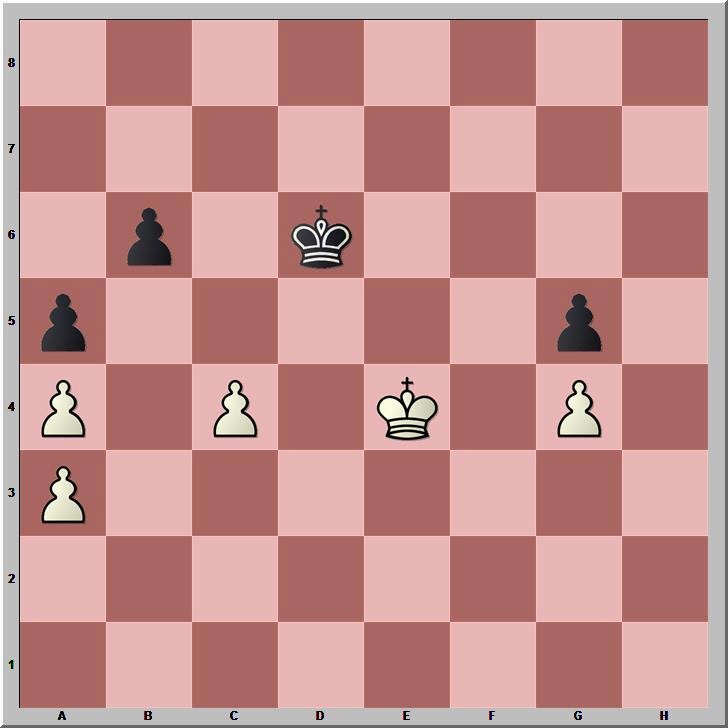
Losing Pawn Wars

This position dates from last October. The game was played online with a fast time control. I had White and a winning ending, but I erred here.

White to move

Second Best

From this position, I played 17.Qh5+, missing the best move. My opponent found the second best move. Then, my reply was second best, too. A sequence of second best moves by both players resulted in an overwhelming advantage for White.

White to move

Would you have found a better move than 17.Qh5+ in a three minute blitz game?

Pawn Promotion

In a blitz game last night, I was handed a gift by my opponent. I was no better in this game. Alas, my opponent was certain that he had a clear win and missed the critical move here. Twelve moves later, I checkmated him with two queens.

White to move

Had my opponent found the correct move here, I almost certainly would have missed my only chance to stay in the game.

Easy

I found myself in this position during a blitz game.

White to move

It was nice to win after yesterday's appalling losses.
Detail: Easy

Blowing an Endgame

Yesterday morning, I shared on Facebook a link to an excellent article from The Chess World, "7 Chess Training Habits You Should Drop Now." The author, Yuri Markushin, highlights several practices that develop sloppy and lazy thinking. He begins with blitz and bullet.

Last night, I played a blitz game that illustrates this problem with blitz. In contrast to calculating the consequences of a rook exchange and then playing the pawn ending correctly, I intuitively guessed that I would benefit from an exchange of rooks and then threw away the pawn ending.

Black to move

32...Re3+ was the correct move. But then, 33.Kd4 Rxa3 34.bxa3, it was time to assess the resulting pawn position.

I played 34...f5, playing hope chess. I hoped that my opponent would facilitate my dreams of a passed pawn with 35.gxf5. He refused to cooperate, playing instead 35.a4.

Did I then seriously consider 35...e5+, a move that may at least hold the draw?

No. I played 35...fxg4 and quickly reached a position that was hopelessly lost. Several moves later, we reached the position below.

White to move

My opponent wins easily with 44.Kf5. However, 44.Kd4 was played. In the ensuing pawn race, we both promoted pawns. The queen ending was a dead draw. But, as often happens in blitz, a series of senseless checks were employed to run the other player out of time.

More Rook Ending Tragicomedies

Thanks to the need to effectively teach the Lucena and Philidor rook endgame positions to a strong young chess player, I have been using my database to review my own games. My OTB (over the board games) reveal some degree of skill, but errors in blitz expose weaknesses in my intuitive understanding.

Blitz can reinforce bad habits, but it may also be useful for diagnosing and correcting those habits.

Black to move

I threw away a decisive advantage with 57...gxh3. This game was played in April 2014.

Black to move

53...Kf4 preserves winning chances, but I played 53...g4?? to reach a dead drawn ending.


The Good News

Despite these many failings, my database reveals an abundance of games in which I was able to convert a Lucena or or similar position.

This one from the Free Internet Chess Server (FICS) in February 2014 shows that I missed the best line, but found a wholly adequate solution nonetheless.

White to move

67.Rf6+ (67.Rb8 was best) 67...Kg3 68.b7 Rb6 69.Kc4 Rb1 70.Kc5 Kg4 71.Kc6 Kg5 72.Kc7 Rc1+ 73.Kb8 Rb1 74.Rc7 Kf6 75.Kc8 Re1 76.b8Q Re8+ 77.Kb7 Rxb8 78.Kxb8 and my opponent opted not to test how quickly I could deliver checkmate with a rook and king against his lone monarch.

I also avoided a trap in this finish from March 2013 on Chess.com. Then I saw a trap that was not there.

White to move

47.Kc6 Rf2 48.Kc5 Rc2+ 49.Kb4 Kc7 50.Ka3 Rc3 51.Kxb2 Rxb3+ 52.Kxb3. Game drawn.


Philidor Position: Practice

Demonstrating fundamental understanding of the Philidor position in rook endings is one of the tests for the Rook Award in my series of scholastic chess awards. Naturally, when I have a student working through that stage, I spend additional time looking through my own games both to find evidence of correct play and to extract study positions where failure occurred.

Tragicomedies abound in my database of online games, which includes thousands of turn-based (correspondence) games, nearly as many "standard" (fifteen minute and longer) live online games, and fifty thousand blitz games. There are dozens of games where the last several moves clearly indicate both players trying to run the other out of time in a dead drawn ending, or even in endings where one player has a decisive advantage but the other manages to win. There are also far too many games where moves played demonstrate intuitive failure or lack of understanding of correct technique.

Using the classification keys in ChessBase 11, I am able to quickly locate hundreds of rook endings and skim through the positions rapidly. With an eye for thematic positions, I seek those with results at odds with the truth of the position. I play out the position from before the error to practice correct technique. This practice also tests my understanding of which positions are drawn and which won or lost.

As White, I threw away a draw from this position, but then won on time a few moves later. The game was played on the Internet Chess Club in August 2000.

White to move

54.Ra6?? loses to 54...Rf6+. My opponent returned the position to drawn status with 54...f4, allowing my rook to maneuver to f1 where it awaited help from its king.

My ICC opponent in 2000 could have held the next position easily by shuffling the rook across to a3, b3, ... Even 78.Rh5, the move played, could have held if not for the blunder several moves later.

White to move

78.Rh5 Kg4 79.Rh3 Re7 80.Rg3+ Kf4 81.Rg2 Rh7+ 82.Kg1 Ke3 83.Rf2?? and I won with a rook swap that took us into an elementary pawn ending. Playing my opponent's position against Stockfish DD earlier this week, I reached a draw in a few seconds of play keeping the rook on the third rank until Black advancd the pawn to f4, then keeping up a barrage of side checks.

My own errors were glaring in the next game.

Black to move

In a three minute game on ICC in 2001, I played 55...Re5?? in this position. My opponent exploited the error to win.

In this game from 2001, I maintained the draw for several moves. Even so, my moves call into question my intuitive sense. Keeping my king in front of Black's pawn should not require conscious thought.

White to move

70.Ke3 (I played 70.Kf3 against Stockfish) 70...Ra3+ 71.Kd4 Ra4+ 72.Kc3?? and I lost the game.

Improvement?

Moving forward in the database to 2006, I should find better play. By then, I had spent at least a little time learning some principles of rook endings, although serious work began in 2007. It was then that I bought Jeremy Silman's new book, Silman's Complete Endgame Course (2007) and quickly went through everything up through the chapter for C Class. In the fall of 2006, I also broke through to B Class with my USCF rating.

After studying the section on the Lucena and Philidor positions in Silman's text, I changed the requirements for my Rook Award. The Lucena and Philidor positions replaced checkmate with a bishop and a knight. Silman's arguments concerning the relative value of each influenced my decision, as did one of my pupils requiring 51 moves to checkmate my king with a bishop and knight after many attempts over several weeks.

In this game on Free Internet Chess Server (FICS), I started well.

White to move

52.Rh3+ Ke4 53.Rb3 f4 54.Kf1 f3

I have occupied the third rank. Black has advanced his pawn.

55.Rb4+ Ke3 56.Rb3+ Kf4 57.Rb4+??

I threw it away. It was time to check from the rear.

In another game on FICS in 2006, I threw away a win.

Black to move

56...f2?? leaves my king unprotected from White's checks. Against Stockfish this week, I won quickly after 56...Re1+.

Several years later, rear checks allowed my to transition into a drawn pawn ending in this game from Chess.com that was played in 2013.

Black to move

70...Rxg3+ 71.Kf4 Rg1 72.Ke5 Re1+ 73.Kd6 Rxe6+ 74.fxe6 Ke8

My opponent tested my time management skills for seven moves before we reached stalemate.

Nonetheless, failures continued to manifest themselves in 2013.

I blew a draw in this game on Chess.com.

White to move

70.Rf3+?? leads to passive first rank defense that is lost (and straight out of the textbooks).

Against the engine, I held the draw after 70.Rb6+ Kc3 71.Kb1.

As recently as January of this year, I demonstrated a continuing need for improvement.

White to move
52.Kh1

Choosing the short side is as effective here as 52.Kf1.

52...f3 53.Rc4+ Kh3 54.Rc1??

54.Rc8 would have been simple and effective. Passive defense leads to checkmate.

The work continues.

The Blind Squirrel

Although I prefer to win by grinding down my opponent to reach a winning endgame, in blitz I reveal aggressive tendencies that arose as a consequence of my first chess book. These aggressive tendencies have manifested themselves in playing 1.e4 almost exclusively for the past several months and playing the Ponziani whenever possible (despite Dave's sage advice). Naturally, playing 1.e4 means that I face the Sicilian Defense in a high percentage of games.

A blitz game against the Sicilian Defense this morning featured blunder after blunder. There is nothing unusual in that fact. Often in online blitz, both players appear bent upon losing. My pursuit of a flawed plan was met by improper defense. Finally, my opponent thought that he had a credible checkmate threat that wins material, but overlooked my best resource.

The worst of the blunders began with this diagram.

White to move

I played 17.Qh6??

17.Qf3 was best, while 17.exd6 was better than the move played.

Instead of the natural straightening out of his doubled pawns, my opponent sought to drive back the bishop.

17...c4??

The game continued 18.exd6  (18.f5 was better) 18...Qxd6? (Black has a slight advantage after 18...Qf6--the aggressively placed White queen should not be ignored) 19.f5

Black to move

I was proud of my decision to offer the bishop. 19...cxd3 loses quickly to 20.f6.

19...Kh8?

Perhaps the simple refutation 19...Rfb8, freeing f8 for the queen is not so easy for Black to see.

20.f6 Rg8 21.Be2

21.Rf4 was best.

21...Qe5 22.Rae1 Qxb2 23.Rf4

Black to move

23...Qc3??

Black is winning after 23...g5.

24.Qxh7+ 1-0

Black resigned.

Blunder follows Blunder

This blitz game was played between two USCF A Class players at the inaugural Collyer Memorial Blitz tournament. The Collyer Memorial is Spokane's strongest annual tournament now in its 22nd year. Yesterday, a blitz tournament preceded the annual lecture and simul by IM John Donaldson.

The players names are withheld per request.

White -- Black [B41]
Collyer Blitz Spokane (2.1), 21.02.2014

1.e4 c5 2.Nf3 e6 3.d4 cxd4 4.Nxd4 a6 5.f4 

This move looks dubious to me.

5...Bc5 6.Be3 

6.Nb3 seems better.

6...Qb6 7.Nc3

Black to move

7...Nc6??

Black throws away the game. 7...Qxb2 looks promising.

Is this pawn poisoned? 8.Na4 Qa3 9.c3 Ba7 seems okay for Black.

8.Nxc6??

White refuses the win.

8.Na4 is something that has happened to me playing the French in blitz. White should win this game. 8...Qa5+

     8...Qa7 is worse 9.Nxc6.

9.c3 Bxd4 10.Bxd4 Nxd4 11.Qxd4 Ne7.

8...Bxe3 9.Ne5 

9.Qd3 may be White's best chance bxc6–+.

9...Bf2+ 0–1

Final position with White to move

Blowing It

In a blunderfest during my lunch break, my opponent and I reached a rook and pawn ending that should be drawn. Suddenly, however, I found myself with a clear advantage and seized the moment, only to toss it away a few moves later.

Black to move
After 37.Re2??
37...Ra3+ 38.Kd2 Rxa2 39.Kd3 Rxe2 40.Kxe2 Ke6 41.Kd3

Black to move

Black's d-pawn will become the queen. The plan is simple: both kings move towards the a-file, which will be the only opening for the kings. As White yields way, the a-pawn advances until the Black king can occupy c4. That's how it worked when I replayed the game from the first diagram against Hiarcs after the game concluded.

I played the game on FICS through the Chess-Wise Pro iPad app. Having some time for review after the game, I reviewed how and why I blew a simple ending.

41...f5?! 42.Kc3 g5? 43.Kb4 f4??

White to move

44.g4 not only deprives Black of the win that he had a few moves ago. It presents Black with an unresolvable set of problems. After rounding up Black's a-pawn, the White king will outflank the Black king to win the d-pawn and the game.

44.Ka5??

White returns the favor. instead of winning the game.

44...fxg3 45.hxg3 h5 46.Kxa6 h4 47.gxh4 gxh4 0-1

It is almost embarrassing to evaluate the truth of the positions that occur during blitz in the light of the result of these games. It sometimes appears that players lack rudimentary skills that every elementary student should know. Indeed, faced with the position in the first diagram this afternoon, a fourth grader that I coach was able to win the game from the Black side against my best efforts while carrying on a conversation concerning Valentine's candy with his classmates.

Detail: Blowing It
Older Post ►
 

Copyright 2011 Chess 2 Skills is proudly powered by blogger.com